
15 Common Electrical Parts Found in a Home
Residential electrical systems use switches, protective devices, boxes, raceways, and connectors to deliver power safely. This guide is for identifying visible components - not for working on energized wiring.
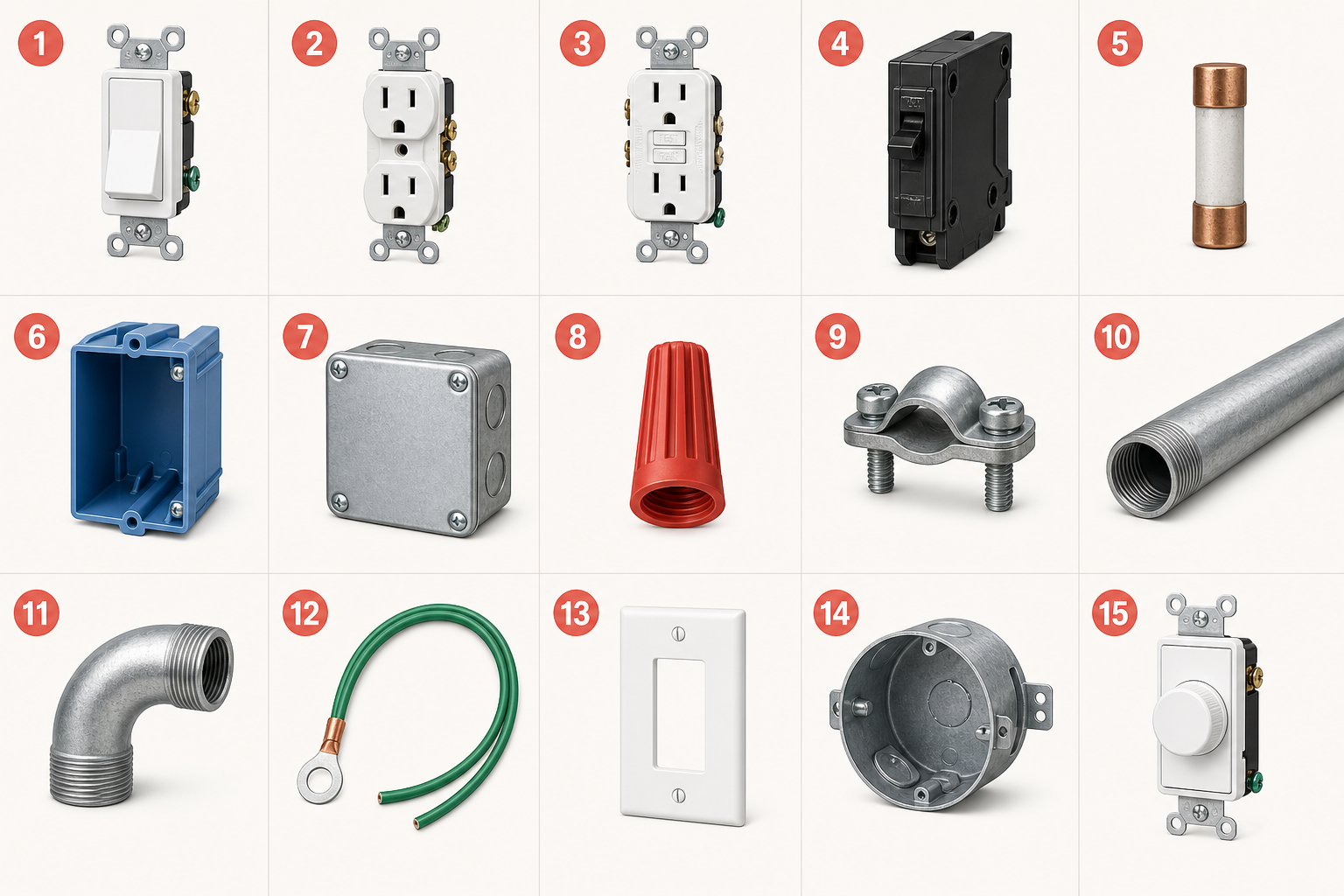
Electrical parts shown in the image
1. Single-pole switch
A single-pole switch controls one circuit from one location. It is commonly used for a light or switched receptacle.
2. Duplex receptacle
A duplex receptacle provides two plug-in outlets on one device. Its voltage, current rating, grounding, and circuit compatibility must match the installation.
3. GFCI receptacle
A ground-fault circuit interrupter monitors current imbalance and can disconnect power rapidly. Test and reset buttons distinguish it from a standard receptacle.
4. Circuit breaker
A breaker protects a circuit against overcurrent and short circuits. It must match the panel model and the conductor and circuit requirements.
5. Cartridge fuse
A fuse contains an element that opens when current exceeds its rating. A blown fuse is replaced rather than reset.
6. Device box
A device box supports switches or receptacles and contains their wire connections. Boxes come in metal and nonmetallic versions for different wiring methods.
7. Junction box
A junction box encloses wire splices or cable transitions. Its cover must remain accessible rather than being buried behind finished surfaces.
8. Twist-on wire connector
This connector joins compatible conductors when installed according to its listed wire range and instructions. Color alone does not guarantee capacity across manufacturers.
9. Cable clamp
A cable clamp secures cable where it enters a box or enclosure and protects it from pull and sharp edges.
10. Conduit
Conduit is a raceway that routes and protects conductors. Metal and nonmetallic types use different fittings and installation rules.
11. Conduit elbow
An elbow changes the direction of a conduit run. Bend radius and conductor fill affect how easily wires can be installed.
12. Grounding conductor
The equipment grounding conductor provides a low-impedance fault path. Green or bare conductors are commonly used for this purpose.
13. Faceplate
A faceplate covers the opening around a switch or receptacle. It helps prevent accidental contact and gives the installation a finished appearance.
14. Ceiling box
A ceiling box contains wiring and supports an approved fixture within its rating. Heavy luminaires and ceiling fans may require specially rated boxes.
15. Dimmer switch
A dimmer changes light output electronically. It must be compatible with the lamp type, load, circuit arrangement, and fixture.
Important safety boundary
Do not remove covers or touch wiring merely to identify a component. Turn off the correct circuit, verify de-energization with appropriate test equipment, and follow applicable requirements. If you are uncertain about the circuit, conductor condition, panel, grounding, or safe work procedure, use a qualified electrician.
Frequently confused parts
- Breaker vs. GFCI: a breaker primarily protects wiring from overcurrent; GFCI protection detects ground-fault imbalance.
- Device box vs. junction box: both are enclosures, but a device box is shaped to mount a switch or receptacle.
- Cable vs. conduit: cable contains conductors in a manufactured assembly; conduit is a pathway through which conductors are routed.