
Parts of an Electrical Outlet: A Labeled Guide
A residential receptacle provides a connection point between a branch circuit and plug-connected equipment. The visible slots are only one part of the assembly; terminals, mounting hardware, an enclosure, conductors, and cable protection complete the installation.
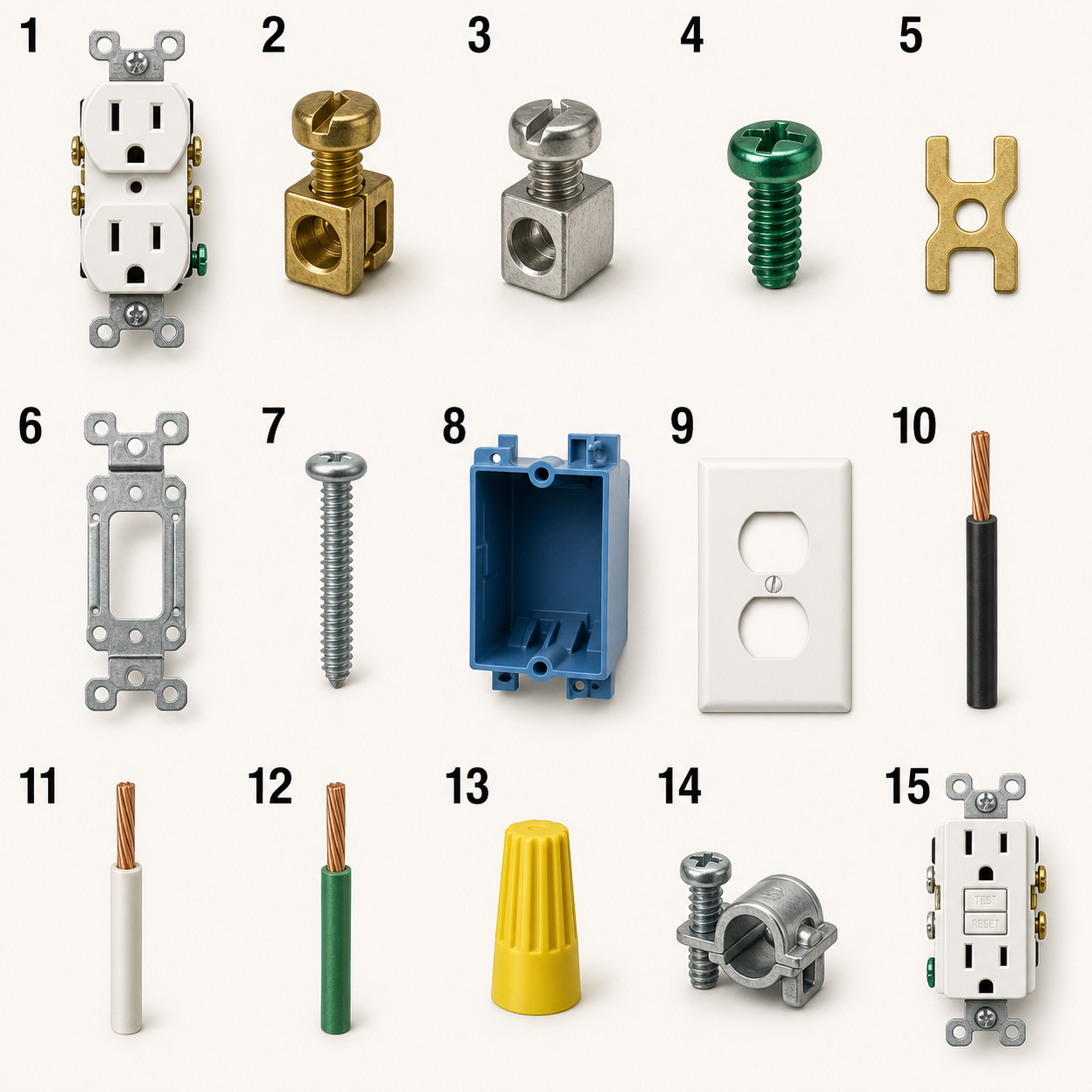
Outlet parts shown in the image
1. Duplex receptacle
A duplex receptacle provides two plug-in outlets on one device. Its voltage, current, grounding, and configuration must match the circuit.
2. Hot terminal screw
Brass-colored terminals normally connect the ungrounded or hot conductor. Device markings, not color alone, control identification.
3. Neutral terminal screw
Silver-colored terminals normally connect the grounded or neutral conductor.
4. Grounding screw
The green screw bonds the receptacle yoke to the equipment grounding conductor where required.
5. Break-off tab
A removable tab joins the two terminal screws on one side. Removing a tab allows certain split or switched configurations.
6. Mounting yoke
The metal yoke supports the receptacle and provides mounting ears for alignment with the box and wall surface.
7. Mounting screw
Machine screws fasten the yoke to threaded holes in the electrical box.
8. Electrical box
The box encloses connections, supports the device, and helps protect surrounding materials.
9. Faceplate
The faceplate covers the box opening and reduces access to energized parts.
10. Hot conductor
The ungrounded conductor carries circuit voltage. Black is common, but other permitted identification may be used.
11. Neutral conductor
The neutral is a grounded circuit conductor and still carries current during normal operation.
12. Equipment grounding conductor
This conductor provides a fault-current path and bonds exposed conductive parts. Bare copper or green insulation is common.
13. Wire connector
A listed connector joins compatible conductors within its specified size and quantity range.
14. Cable clamp
The clamp secures cable at the box and protects it from movement and sharp entry edges.
15. GFCI receptacle
A ground-fault circuit interrupter monitors current imbalance and disconnects power rapidly when a ground fault is detected.
Important safety boundary
Slot shape and screw color are not enough to prove how an outlet is wired. Never assume a circuit is off because a switch is open or a device does not work. Electrical identification behind a faceplate requires de-energizing the correct circuit and verifying absence of voltage with appropriate equipment.
Heat damage, buzzing, loose mounting, repeated breaker trips, aluminum branch wiring, wet locations, missing grounding, or uncertain conductor identification should be handled by a qualified electrician.