
Types of Wall Anchors: Which One Should You Use?
A wall anchor creates a stronger attachment when a screw cannot enter a stud or other structural backing. Anchor capacity depends on the wall material, thickness, installation quality, fastener size, load direction, and the manufacturer's tested rating.
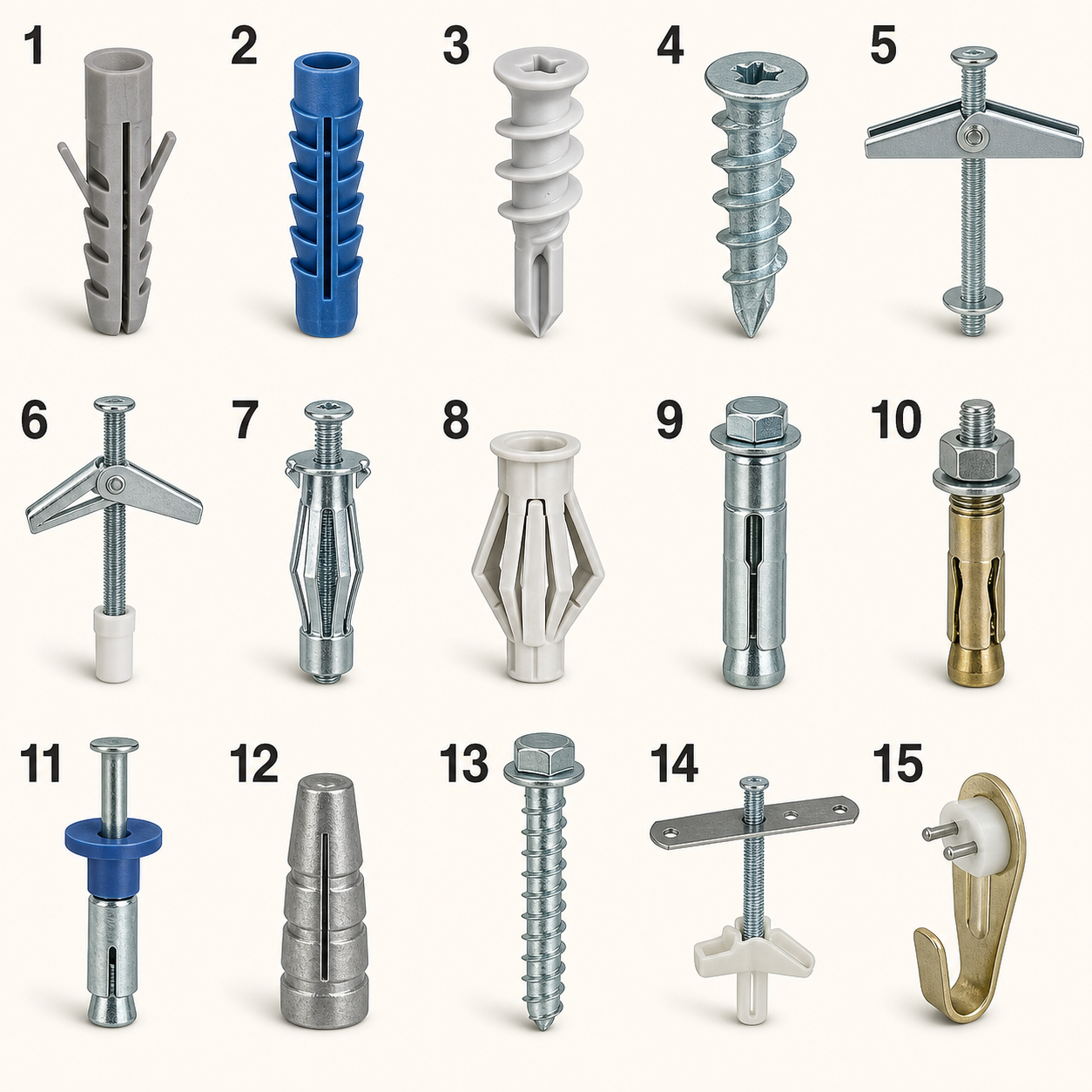
Anchors shown in the image
1. Plastic expansion anchor
This basic sleeve expands as a screw enters. It is intended for light loads in suitable solid or hollow materials.
2. Ribbed anchor
External ribs resist rotation and improve grip in a correctly sized drilled hole.
3. Self-drilling drywall anchor
A coarse plastic body cuts into drywall without a separate pilot hole in many installations.
4. Threaded metal drywall anchor
The metal version uses deep threads and offers greater durability than many plastic self-drilling anchors.
5. Toggle bolt
Spring wings open behind a hollow wall. The wings usually fall away if the bolt is fully removed.
6. Snap-toggle anchor
A metal channel is positioned behind the wall and held by plastic straps. The bolt can often be removed and reinstalled.
7. Molly bolt
The metal sleeve expands behind the wall as the screw is tightened or set with a tool.
8. Hollow-wall anchor
This broad family includes anchors that clamp against the back of drywall or paneling.
9. Sleeve anchor
A sleeve expands in concrete or masonry as its nut or bolt is tightened.
10. Wedge anchor
A wedge anchor develops strong expansion force in solid concrete. Edge distance and embedment are critical.
11. Hammer-drive anchor
A pin is driven into the body to expand it. These are generally intended for permanent light-duty attachment.
12. Lead anchor
A soft metal body expands around a screw or bolt in masonry. Compatibility and environment affect selection.
13. Concrete screw
Hardened threads cut into a correctly drilled masonry hole. Diameter, hole depth, and cleaning follow the manufacturer's instructions.
14. Strap toggle
A strap system holds a metal toggle behind the wall while the front collar is set at the surface.
15. Picture-hook anchor
This compact hanger supports framed art using angled pins or a small wall anchor, depending on its design.
Which anchor should you choose?
Start by identifying drywall, plaster, concrete, brick, block, or tile. Then confirm wall thickness, cavity depth, load weight, load direction, vibration, moisture exposure, and whether the item could injure someone if it falls. Use the exact screw or bolt supplied or specified for the anchor.
Do not rely on hollow-wall anchors for grab bars, heavy cabinets, ceiling-mounted loads, large televisions, or other safety-critical items unless an engineered product and installation method explicitly permit it. Structural backing is usually the safer choice.