
15 Types of Door Hinges Explained
Hinges differ in leaf shape, pivot position, bearing design, closing action, and how much of the hardware remains visible. The right hinge depends on the door or cabinet construction, weight, swing, clearance, and required durability.
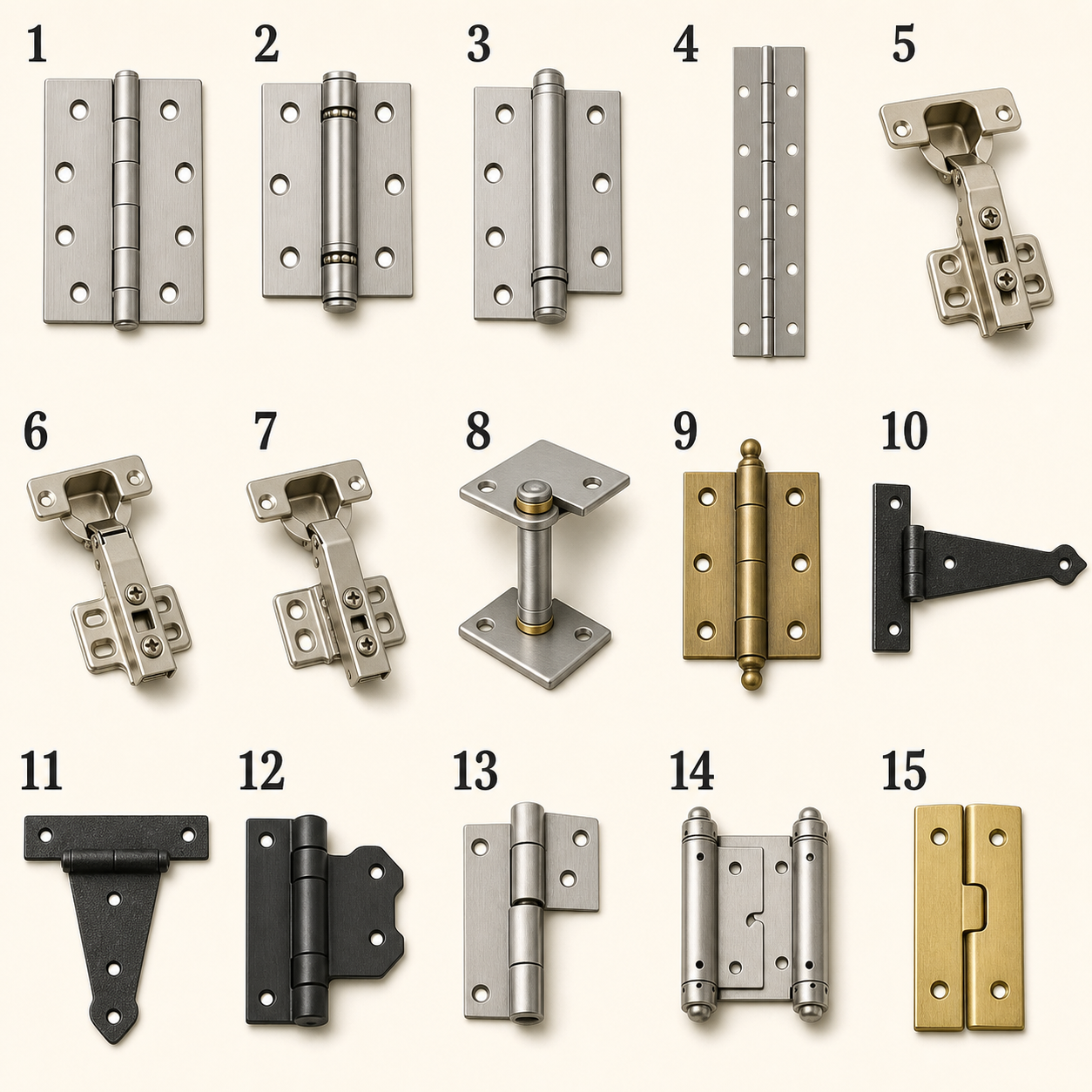
Hinges shown in the image
1. Butt hinge
Two rectangular leaves meet around a central pin. This is the standard choice for many interior and exterior doors.
2. Ball-bearing hinge
Bearings between the knuckles reduce friction. These hinges suit heavier or frequently used doors.
3. Spring hinge
An internal spring helps return the door toward the closed position. Tension must be adjusted within the product instructions.
4. Piano hinge
Also called a continuous hinge, it runs along much of the door or lid length and spreads the load across a wide area.
5. Concealed cabinet hinge
A cup-style concealed hinge sits inside the cabinet door and is mostly hidden when the door is closed.
6. Overlay hinge
An overlay hinge positions a cabinet door over the face frame or cabinet side. Overlay dimension is a key selection measurement.
7. Inset hinge
An inset hinge supports a door that closes within the cabinet opening rather than covering its edge.
8. Pivot hinge
A pivot hinge supports the door from points near its top and bottom instead of from a pin along the side edge.
9. Barrel hinge
Small cylindrical halves fit into drilled holes. Barrel hinges are often used for compact boxes and specialty cabinet work.
10. Strap hinge
Long narrow leaves spread load across a gate, shed door, or rustic door surface.
11. T-hinge
A T-hinge combines a vertical mounting leaf with a long strap. It is common on utility doors and gates.
12. Gate hinge
Gate hinges are designed for outdoor loads and wide swings. Their geometry and adjustability vary considerably.
13. Rising-butt hinge
Helical knuckles lift the door slightly as it opens, providing clearance over uneven floors or thick carpet.
14. Double-action hinge
This hinge lets a door swing in both directions and returns it toward center. It is common on service doors.
15. Knife hinge
Thin flat leaves pivot like two blades. Knife hinges are used in fine cabinetry where discreet hardware is desired.
Measurements that matter
Confirm door thickness, weight, height, handing, hinge size, screw pattern, mortise depth, swing angle, and fire-rating requirements. Exterior and fire doors need hardware approved for their assembly. A similar-looking cabinet hinge may have a different cup depth, overlay, or opening angle.
Sagging doors can also result from loose screws, a damaged jamb, an undersized hinge, or frame movement. Heavy doors and rated openings should be repaired with suitable hardware rather than improvised fasteners.