
Parts of a Door Lock: A Labeled Diagram
A residential entry lock transfers motion from a lever or knob to a spring latch, while a deadbolt provides a separate locking bolt. Knowing the component names makes it easier to describe a problem and order compatible hardware.
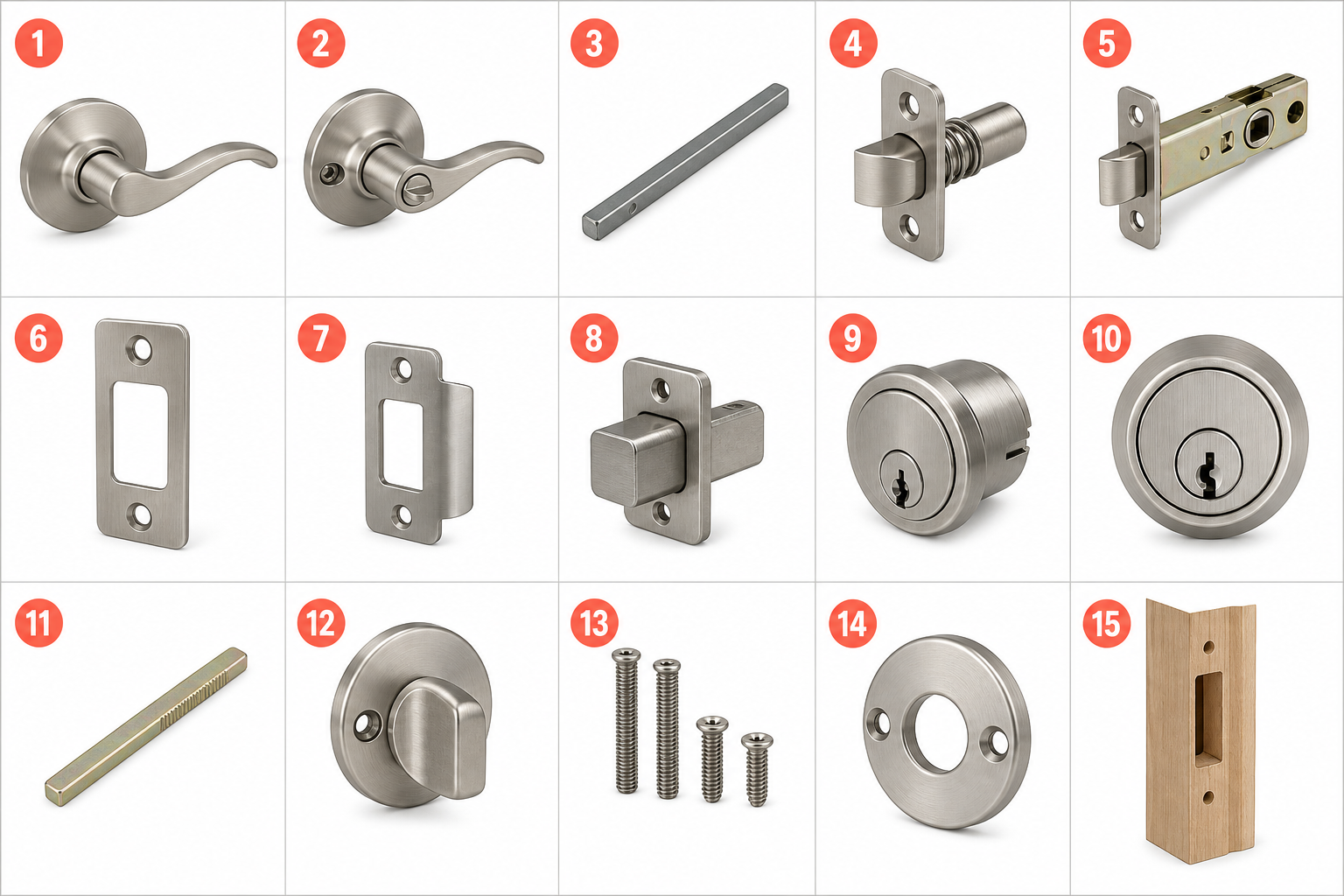
Door lock parts shown in the image
1. Exterior lever
The exterior lever operates the latch from outside. On a keyed entry set, it is paired with a cylinder or another locking control.
2. Interior lever
The interior lever retracts the latch from inside. Entry locks often include a turn button or push button on this side.
3. Spindle
The spindle passes through the latch mechanism and transfers rotation from one lever to the other and into the latch body.
4. Latch bolt
The spring-loaded latch bolt slides into the strike plate when the door closes. Its beveled face lets it retract as it meets the strike.
5. Latch body
The latch body houses the spring and retraction mechanism. Its backset must match the distance from the door edge to the handle centerline.
6. Latch faceplate
The faceplate sits flush with the door edge and secures the latch body. Rounded and square-corner plates require matching mortises.
7. Strike plate
The strike plate mounts to the jamb and receives the latch bolt. Proper alignment helps the door close without lifting, pushing, or slamming.
8. Deadbolt bolt
The deadbolt extends farther into the jamb than a spring latch and does not retract by simply pushing against its face.
9. Key cylinder
The cylinder contains the keyed mechanism. The correct key aligns its internal components so the cylinder can rotate.
10. Keyway
The keyway is the shaped opening where the key enters. Its profile is only one part of key compatibility; internal pinning also matters.
11. Tailpiece
The tailpiece extends from the back of the cylinder and transfers rotation to the deadbolt or lock mechanism.
12. Thumb turn
The interior thumb turn locks or unlocks a deadbolt without a key. Its orientation must match the bolt position during assembly.
13. Mounting screws
Mounting screws clamp the interior and exterior trim together through the door. Strike screws secure the strike plate separately to the jamb.
14. Trim rose
The rose is the round trim plate behind a lever, knob, cylinder, or thumb turn. It covers the bored hole and mounting hardware.
15. Door jamb
The jamb is the vertical frame member beside the door. The strike plate and reinforced screw attachment rely on this structure.
Latch vs. deadbolt
A latch bolt is spring loaded and retracts when the handle turns. A deadbolt moves only when a key, thumb turn, or powered mechanism operates it. Many exterior doors use both.
Measurements that matter
Before buying a replacement, check door thickness, bore diameter, backset, handing requirements, faceplate shape, and the distance between lock components. Reinforcement hardware must suit the door and jamb construction.