
15 Types of Screws and Where They Are Used
Screws differ in head shape, drive style, thread spacing, tip design, material, and coating. Those details determine which driver fits, what material the screw can enter, and whether it is suitable for structural, exterior, or finish work.
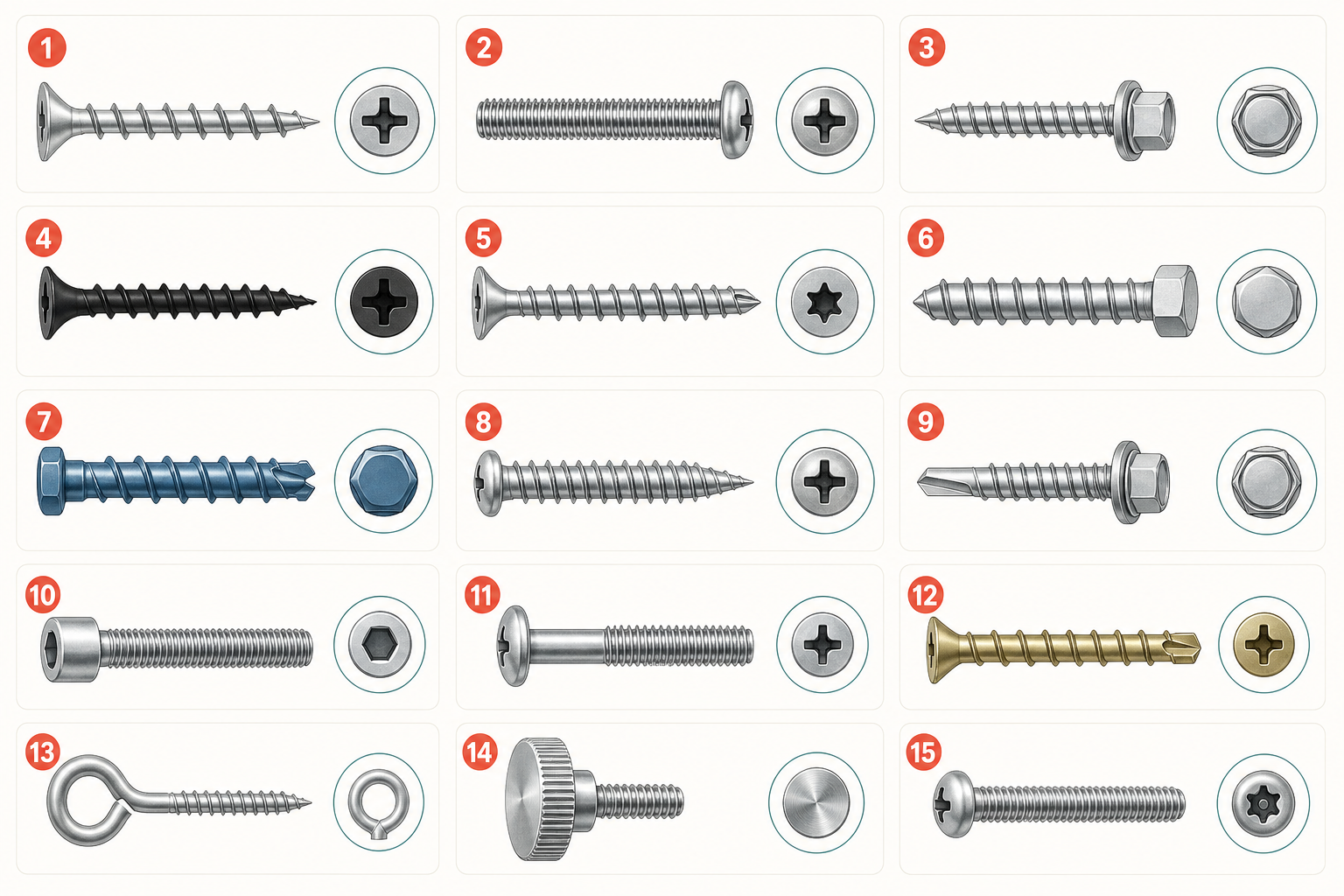
Screw types shown in the image
1. Wood screw
Wood screws have a sharp point and threads designed to grip wood fibers. A partially unthreaded shank can help pull two boards together.
2. Machine screw
Machine screws use uniform threads and typically mate with a nut or tapped hole. They are common in appliances, fixtures, and metal assemblies.
3. Sheet-metal screw
Sheet-metal screws form or engage threads in thin metal and some plastics. Their sharp threads extend close to the head.
4. Drywall screw
Drywall screws have a bugle-shaped head that seats into gypsum board. They are intended for attaching drywall, not for general structural connections.
5. Deck screw
Deck screws use corrosion-resistant coatings or materials and are designed for exterior wood. Product ratings should match the lumber treatment and environment.
6. Lag screw
Lag screws are heavy fasteners with coarse wood threads and a hex head. They require an appropriately sized pilot hole in many applications.
7. Concrete screw
Concrete screws use hardened threads designed for a correctly drilled masonry hole. Hole diameter, depth, and cleaning directly affect performance.
8. Self-tapping screw
A self-tapping screw forms mating threads as it is driven into a prepared hole. It does not always drill its own starting hole.
9. Self-drilling screw
A self-drilling screw has a drill-like point that can create its own hole in suitable metal thicknesses before the threads engage.
10. Socket-head cap screw
This machine screw has a cylindrical head with an internal hex drive. It provides strong clamping where side clearance is limited.
11. Cabinet screw
Cabinet screws are designed for cabinet installation and assembly. Many use a wide washer-style head to spread load without a separate washer.
12. Masonry screw
Masonry screws are hardened for concrete, brick, or block. Always use the bit size and embedment specified for the selected product.
13. Eye screw
An eye screw forms a loop for light attachment, hanging, or guiding cable. Open and closed eyes have different load behavior and should not be assumed structural.
14. Thumb screw
A thumb screw has a large textured head intended for hand tightening. It is useful where a panel or adjustment must be removed frequently.
15. Security screw
Security screws use uncommon or tamper-resistant drive patterns. Matching removal bits may be required for later service.
Drive style is not the screw type
Phillips, slotted, square, Torx-style, and hex describe the drive recess, not necessarily the screw's application. A deck screw and a machine screw can use the same drive while having very different threads and materials.
How to choose safely
Confirm the base material, required length, diameter, load, corrosion exposure, head clearance, and manufacturer rating. Structural connections should use fasteners specifically approved for that application; appearance alone is not enough.