
15 Common Hand Tools and Their Uses
A compact tool kit can handle measurement, adjustment, cutting, gripping, and light assembly. The key is using each tool for its intended job instead of forcing the nearest substitute.
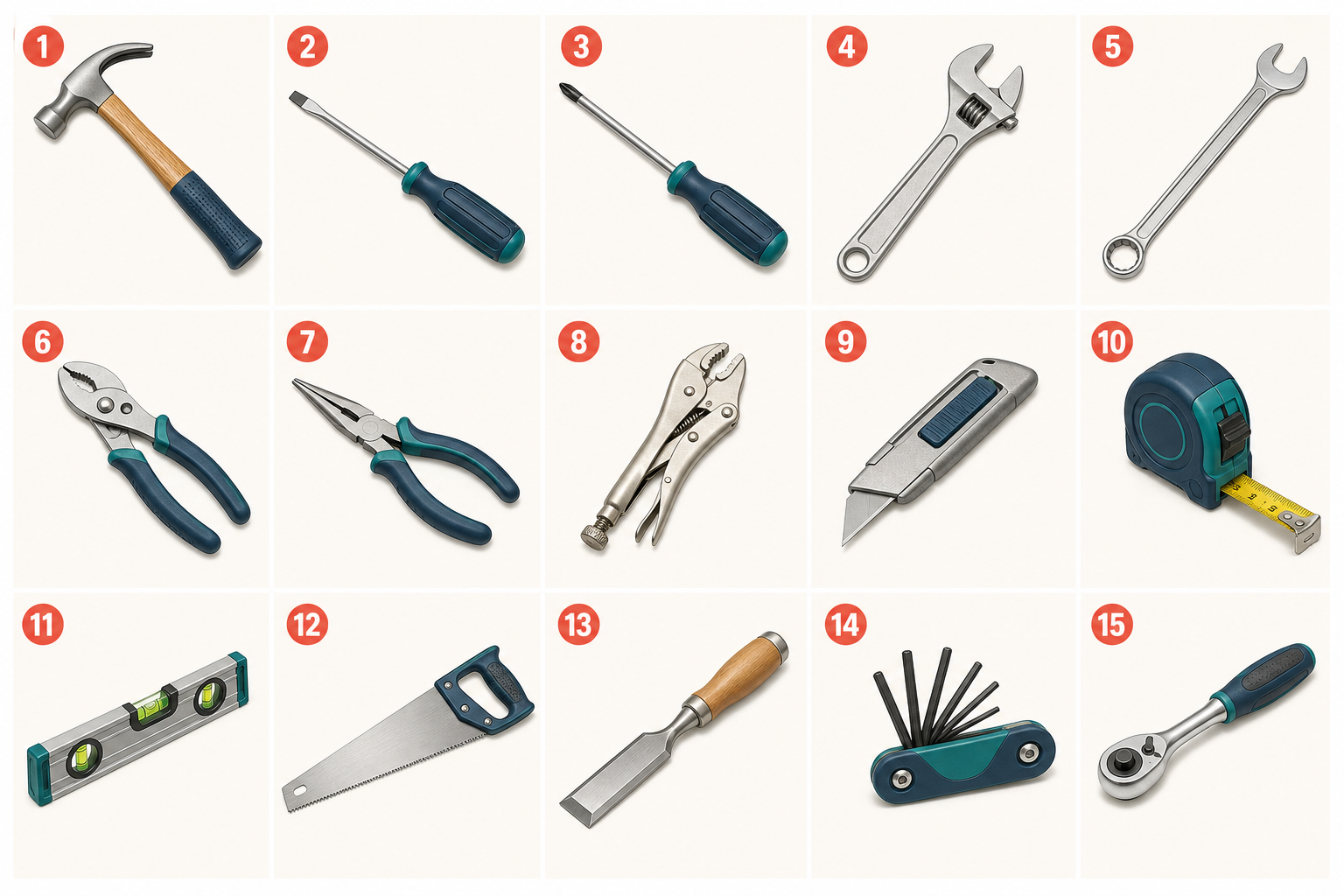
Tools shown in the image
1. Claw hammer
The flat face drives nails, while the curved claw removes them. It is not a substitute for a metalworking or demolition hammer.
2. Flat-head screwdriver
The flat blade fits a single straight slot. The blade width and thickness should match the screw to avoid slipping and damage.
3. Phillips screwdriver
The cross-shaped tip fits Phillips screws. Several tip sizes exist, so a driver that only partly engages can strip the recess.
4. Adjustable wrench
An adjustable jaw fits several nut sizes. Keep the fixed jaw on the side receiving the greatest force and remove jaw play before turning.
5. Combination wrench
A combination wrench has an open end and a box end in the same size. The box end usually grips more securely when space permits.
6. Slip-joint pliers
Slip-joint pliers have two jaw positions for gripping varied objects. Their serrated jaws can mark finished fittings.
7. Needle-nose pliers
Long narrow jaws reach confined spaces and bend small wire. They are not intended for high-torque nuts or hardened cutting.
8. Locking pliers
Locking pliers clamp onto an object and remain locked until released. Excessive pressure can deform tubing, fasteners, and finished surfaces.
9. Utility knife
A utility knife makes controlled cuts in sheet materials, packaging, caulk, and flooring products. Retract or cover the blade when not in use.
10. Tape measure
A retractable tape measures length and layout. The movable hook compensates for its own thickness during inside and outside measurements.
11. Spirit level
The liquid vials indicate level and plumb. Check the reading in both directions if accuracy matters, because a damaged vial or frame can mislead.
12. Hand saw
A hand saw cuts wood and sheet goods using a toothed blade. Tooth count and tooth geometry influence cut speed and finish.
13. Wood chisel
A chisel pares wood and cleans joints. Keep the cutting edge sharp and direct force away from hands and body.
14. Hex-key set
Hex keys operate fasteners with internal hexagonal recesses. Metric and inch sizes can appear nearly identical but are not reliably interchangeable.
15. Socket ratchet
A ratchet turns removable sockets while allowing the handle to reset without leaving the fastener. Socket drive size and fastener size are separate measurements.
Building a useful starter kit
Choose tools that fit the fasteners and materials actually found in your home. Add eye protection, work gloves suited to the task, a flashlight, and a non-contact voltage detector used according to its instructions. Replace damaged handles, cracked insulation, mushroomed striking surfaces, and dull blades.