
Types of Wrenches and When to Use Each One
Wrenches turn fasteners, fittings, pipe, and specialty components. Jaw shape, contact area, leverage, and torque control determine which wrench fits a job. Using the nearest-looking tool can round a fastener or damage a finished surface.
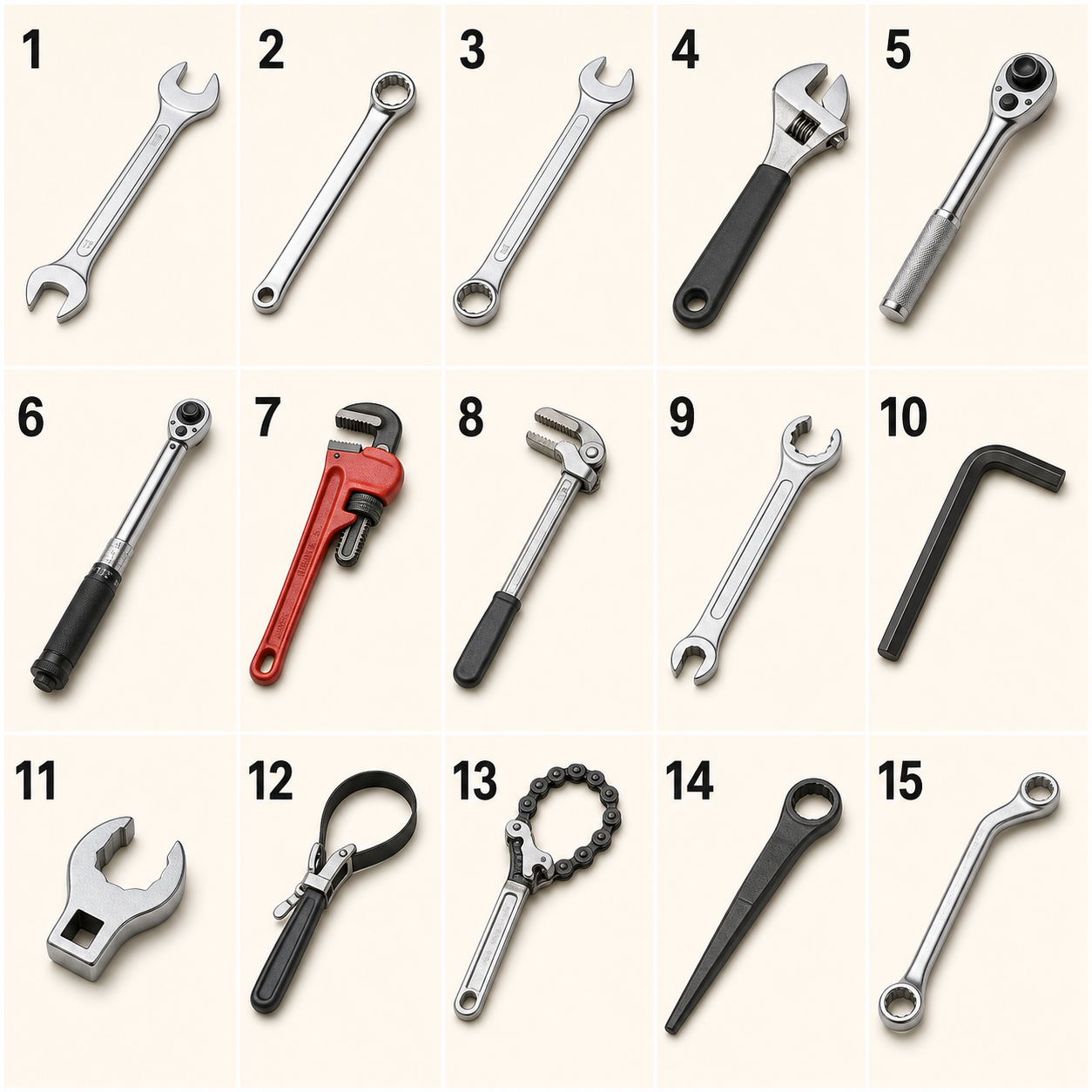
Wrenches shown in the image
1. Open-end wrench
Two flat jaws slide onto a nut from the side. It works in tight spaces but contacts fewer fastener surfaces than a box end.
2. Box-end wrench
A closed ring surrounds the fastener head for secure engagement. Six-point designs resist rounding better than many 12-point designs.
3. Combination wrench
This common tool places an open end and a box end of the same size on one handle.
4. Adjustable wrench
A movable jaw fits several nut sizes. Remove jaw play and pull so the fixed jaw carries the greater load.
5. Socket wrench
A ratchet handle drives removable sockets and resets without being lifted from the fastener.
6. Torque wrench
A torque wrench indicates or limits applied torque. It is a measuring tool and should be stored and calibrated as its instructions specify.
7. Pipe wrench
Serrated jaws bite into round metal pipe. They can crush thin tubing and will mark decorative fittings.
8. Basin wrench
A pivoting jaw on a long shaft reaches faucet mounting nuts behind a sink basin.
9. Flare-nut wrench
Also called a line wrench, its nearly closed head grips more sides of a tubing nut while passing over the line.
10. Allen key
This L-shaped hex key drives screws with an internal hexagonal recess. Metric and inch sizes are not reliably interchangeable.
11. Crowfoot wrench
An open wrench head accepts a ratchet or extension where a normal handle cannot fit. It can alter torque calculations depending on orientation.
12. Strap wrench
A flexible strap grips polished, plastic, or irregular round objects without metal teeth.
13. Chain wrench
A chain wraps around large round work and develops strong grip. It can mar the surface.
14. Spud wrench
A spud wrench combines a wrench head with a tapered alignment handle for structural and industrial assembly work.
15. Offset wrench
An offset head reaches recessed fasteners or clears nearby obstructions.
Choosing the right wrench
Match the exact fastener size and system, use a six-point socket for stubborn hex fasteners where possible, and stop if the tool begins to slip. Do not extend a wrench with a pipe unless the tool and procedure are designed for it. Plumbing, gas, brake, refrigeration, structural, and critical-torque connections may require specialized tools and qualified work.