
Parts of a Kitchen Faucet: A Visual Guide
A pull-down kitchen faucet may look like one simple fixture, but its water path, controls, mounting hardware, and retracting hose depend on many individual parts. The guide below identifies 15 common components.
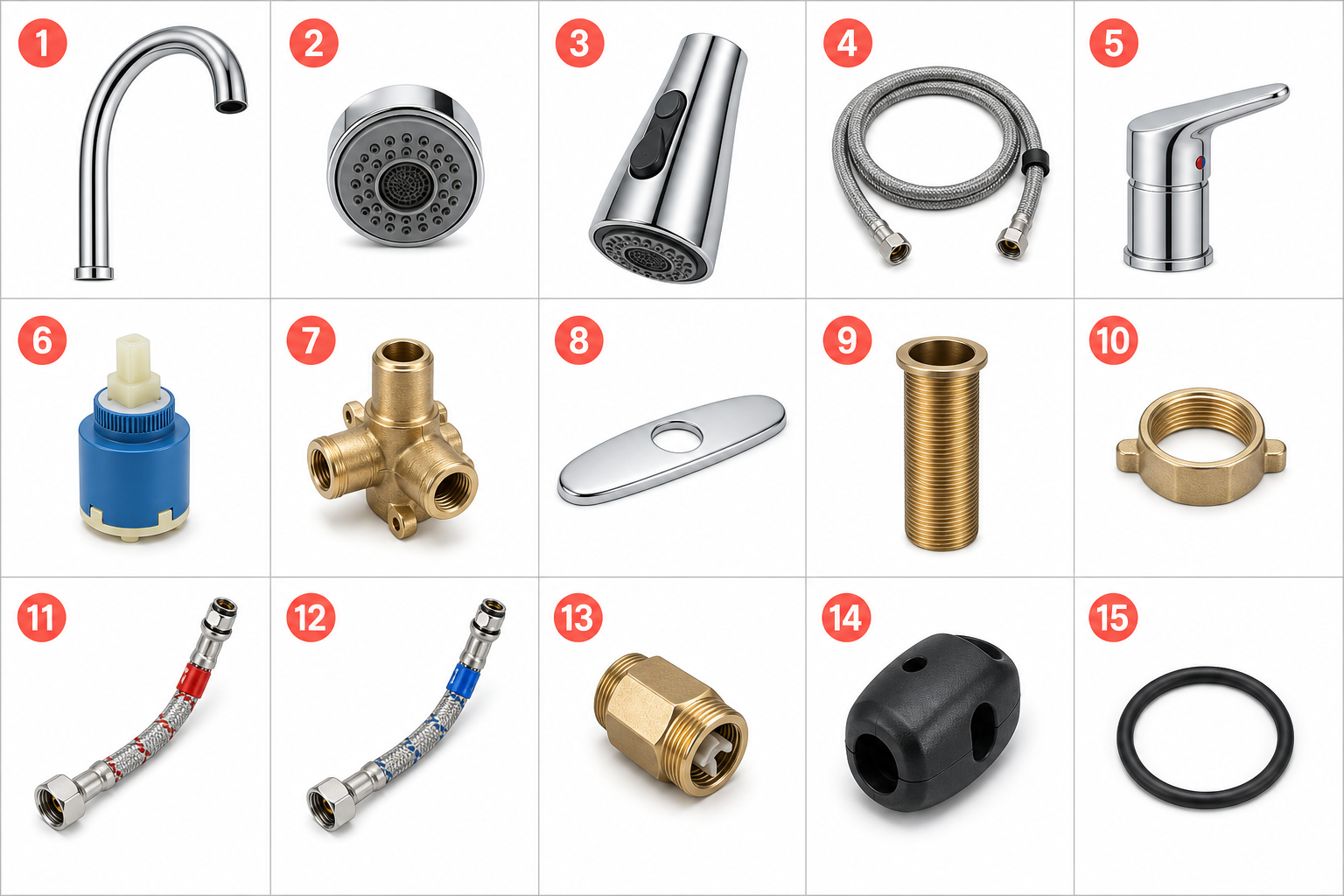
Faucet parts shown in the image
1. Spout
The spout carries water above the sink and positions the outlet. Its height and reach determine how much working space is available below it.
2. Aerator or spray face
The outlet screen mixes air with water or shapes the spray. Mineral deposits here can reduce flow or produce an uneven stream.
3. Pull-down spray head
The spray head detaches from the spout and may switch between stream and spray modes. It connects directly to the pull-down hose.
4. Pull-down hose
This flexible braided hose lets the spray head extend into the sink. It passes through the spout and must move without rubbing against objects below the counter.
5. Control handle
The handle changes flow and temperature. A single-handle faucet moves the internal cartridge to mix hot and cold water.
6. Cartridge
The cartridge is the primary control valve. Worn seals or ceramic surfaces can cause dripping, stiffness, or poor temperature control.
7. Valve body
The valve body holds the cartridge and routes hot, cold, and mixed water. It is the structural center of the faucet assembly.
8. Escutcheon or deck plate
The escutcheon covers mounting holes and creates a finished surface at the sink or countertop. Some faucets install without one.
9. Mounting shank
The threaded shank passes through the sink or countertop. It helps align the faucet and receives the mounting hardware below.
10. Mounting nut
The mounting nut clamps the faucet to the sink deck. A loose nut can allow the entire faucet body to rotate or wobble.
11. Hot supply line
The hot line connects the faucet to the hot-water shutoff valve. Red markings are commonly used to distinguish it from the cold line.
12. Cold supply line
The cold line connects to the cold-water shutoff. Its fittings must match the valve outlet without cross-threading or forced adapters.
13. Check valve
A check valve permits flow in one direction and helps prevent reverse flow. Some pull-down systems place one near a hose connection.
14. Hose counterweight
The counterweight helps retract the spray hose after use. It must be positioned according to the faucet instructions and allowed to move freely.
15. O-ring
An O-ring seals a joint between faucet parts. The correct diameter, thickness, and material are essential; a similar-looking ring may not seal reliably.
Frequently confused parts
- Aerator vs. spray head: the aerator is the outlet screen; the spray head is the complete detachable assembly.
- Cartridge vs. valve body: the cartridge moves to control water; the body holds it and directs flow.
- Mounting shank vs. mounting nut: the shank passes through the deck; the nut tightens onto it below.
Before ordering a replacement part
Identify the faucet manufacturer and model whenever possible. Cartridges, spray heads, quick-connect fittings, and O-rings are not universally interchangeable. Shut off both supply valves and verify that flow has stopped before opening a water connection.