
Parts of a Kitchen Sink: Names and Functions
A kitchen sink installation combines the visible basin and faucet with drain, water-supply, mounting, disposal, and dishwasher connections below the counter. Knowing the names of these parts makes leaks and fit problems much easier to describe.
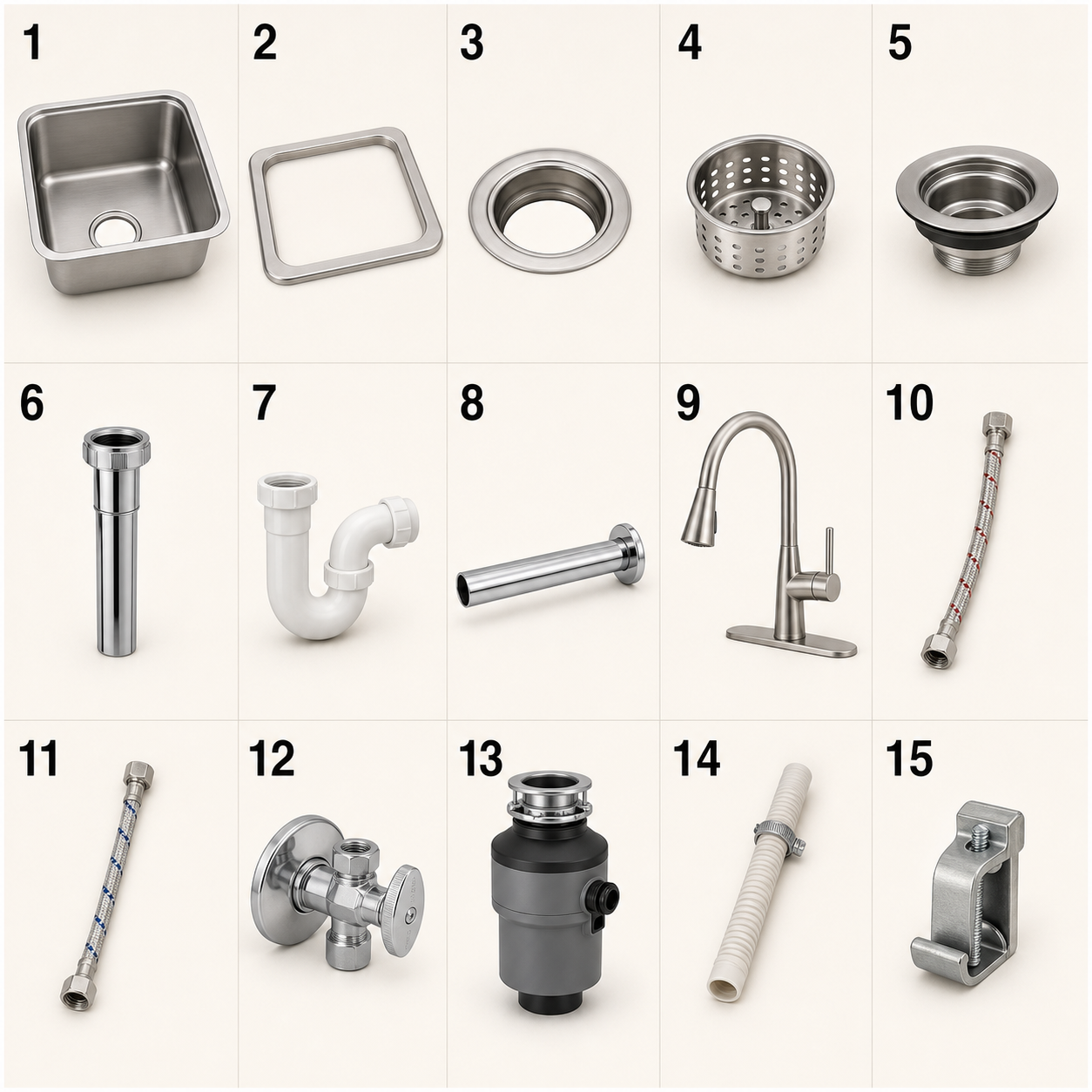
Kitchen sink parts shown in the image
1. Sink basin
The basin holds water and directs it toward the drain. Stainless steel, cast iron, composite, and fireclay basins have different weight and mounting needs.
2. Sink rim
The rim is the perimeter edge. On a drop-in sink it rests above the counter; an undermount sink attaches below it.
3. Drain opening
The drain opening is the formed hole where the strainer or disposal flange is installed.
4. Strainer basket
The basket catches larger food particles and can often close the drain when rotated or pressed into place.
5. Strainer flange
The flange seals the strainer assembly to the sink and provides a finished edge around the opening.
6. Tailpiece
The tailpiece carries wastewater downward from the strainer body to the trap or a branch fitting.
7. P-trap
The P-trap retains water to block sewer gases while providing a removable section for service.
8. Trap arm
The trap arm connects the trap to the drain pipe in the wall. Its slope and distance to the vent matter.
9. Faucet
The faucet controls hot and cold water and positions the outlet above the basin.
10. Hot supply line
This flexible connector carries hot water from its shutoff valve to the faucet.
11. Cold supply line
The cold connector serves the other faucet inlet. Supply lines must match both connection sizes and pressure requirements.
12. Shutoff valve
An angle or straight stop lets the faucet supply be isolated without shutting off the entire home.
13. Garbage disposal
A disposal grinds suitable food waste and discharges it into the drain system. It requires the correct flange, electrical connection, and drain height.
14. Dishwasher drain hose
This hose carries dishwasher wastewater to a disposal inlet, branch tailpiece, or approved air-gap arrangement.
15. Mounting clip
Clips secure many drop-in and undermount sinks. Their type and spacing depend on the sink and countertop material.
Frequently confused parts
- Strainer basket vs. flange: the basket is removable; the flange is fixed to the sink.
- Tailpiece vs. trap arm: the tailpiece is generally vertical; the trap arm runs toward the wall.
- Supply line vs. drain hose: supply lines carry pressurized clean water; drain hoses carry wastewater.
- Disposal flange vs. strainer: a disposal uses its own mounting flange and ring assembly.
Before replacing a sink, measure the cabinet, counter cutout, basin depth, drain height, faucet-hole layout, and available disposal clearance. Countertop modification, hidden leaks, electrical work, or a drain layout that does not fit should be handled by qualified tradespeople.