
15 Types of Plumbing Fittings and Their Uses
Plumbing fittings connect pipes, change the direction of a run, close an opening, or control water flow. The right fitting depends on pipe material, nominal size, pressure rating, temperature, and the connection method. The numbered guide below shows 15 fittings commonly found in residential plumbing.
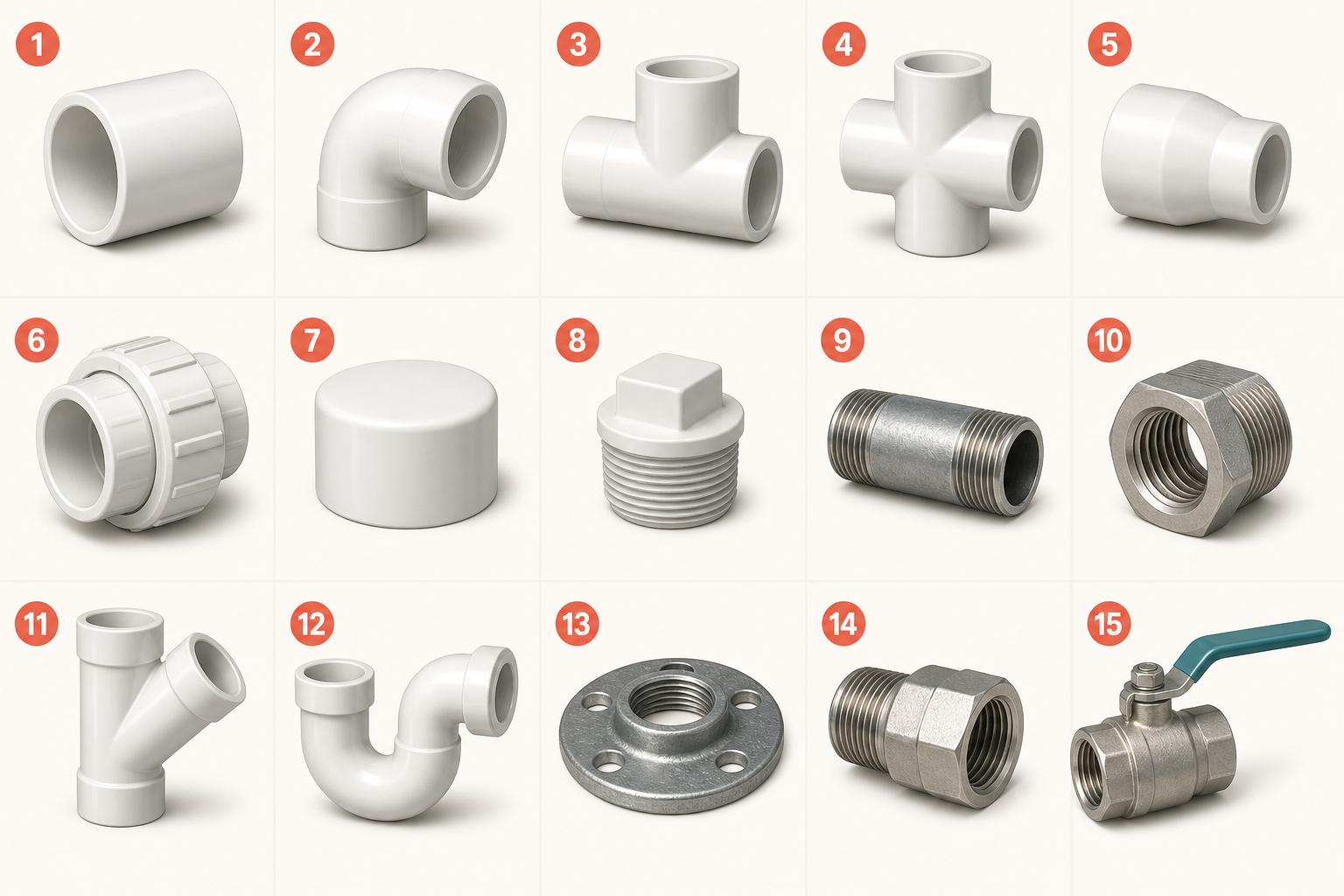
The 15 fittings in the image
1. Coupling
A coupling joins two pipes of the same nominal size in a straight line. Standard couplings are permanent once glued, soldered, pressed, or otherwise secured.
2. Elbow
An elbow changes the direction of a pipe run. The most familiar versions turn 90 or 45 degrees; long-sweep elbows create a gentler path for drainage.
3. Tee
A tee has one inlet and two outlets arranged in a T shape. It creates a branch at roughly 90 degrees and is widely used in water-supply systems.
4. Cross fitting
A cross fitting has four openings. It can connect intersecting runs, although it is less common in houses because several branches meet at one compact point.
5. Reducer
A reducer connects pipes with different diameters. Its tapered body keeps the transition more gradual than a simple reducing bushing.
6. Union
A union joins two pipes while allowing them to be separated without cutting. The center nut makes it useful near pumps, water heaters, and serviceable equipment.
7. Cap
A cap fits over the outside of a pipe end. It permanently or temporarily closes the end of a run, depending on the material and connection method.
8. Plug
A plug fits inside a threaded fitting or opening. It serves the same basic closing function as a cap but engages internal threads instead of covering the pipe exterior.
9. Pipe nipple
A nipple is a short length of pipe with male threads on both ends. It connects two female-threaded fittings or extends a threaded connection.
10. Reducing bushing
A reducing bushing fits into a larger threaded or socket opening and provides a smaller connection. It makes a compact size transition where space is limited.
11. Wye fitting
A wye creates an angled branch shaped like the letter Y. Its smoother entry is better suited to drainage flow than the abrupt turn of a standard pressure-pipe tee.
12. P-trap
A P-trap holds a small amount of water to block sewer gases from entering a room. It is installed beneath sinks and other fixtures that require a trapped drain.
13. Flange
A flange creates a broad mounting or connection surface. Depending on the application, it may be bolted to another flange, secured to a floor, or used to attach equipment.
14. Adapter
An adapter changes connection styles, such as socket-to-threaded or male-to-female. Adapters help different pipe systems or fixture connections work together.
15. Ball valve
A ball valve controls flow with a quarter-turn handle. When the handle is parallel to the pipe, the valve is generally open; perpendicular usually means closed.
Choosing the correct fitting
Never select a fitting by appearance alone. Confirm the pipe material, nominal size, thread standard, pressure rating, temperature rating, and whether the fitting is approved for potable water or drainage. Parts that look interchangeable may use different dimensions or sealing methods.
Frequently confused fittings
- Cap vs. plug: a cap covers an outside end; a plug closes an inside opening.
- Coupling vs. union: a coupling creates a simple joint; a union is designed to come apart.
- Tee vs. wye: a tee creates a sharper branch; a wye guides drainage at a gentler angle.
- Reducer vs. bushing: both change size, but a reducer usually has a longer transition.
Related guides
- What Is a P-Trap and How Does It Work?
- Parts of a Kitchen Sink: Names and Functions
- Parts of a Toilet Tank: 15 Components Explained
For pressurized, concealed, gas, or code-regulated piping, use the manufacturer's instructions and consult a licensed professional.