
Parts of a Rain Gutter System Explained
A rain gutter system collects water at the roof edge and carries it to a controlled discharge point. Its performance depends on slope, outlet capacity, secure attachment, clear flow paths, and a discharge location that moves water away from the building.
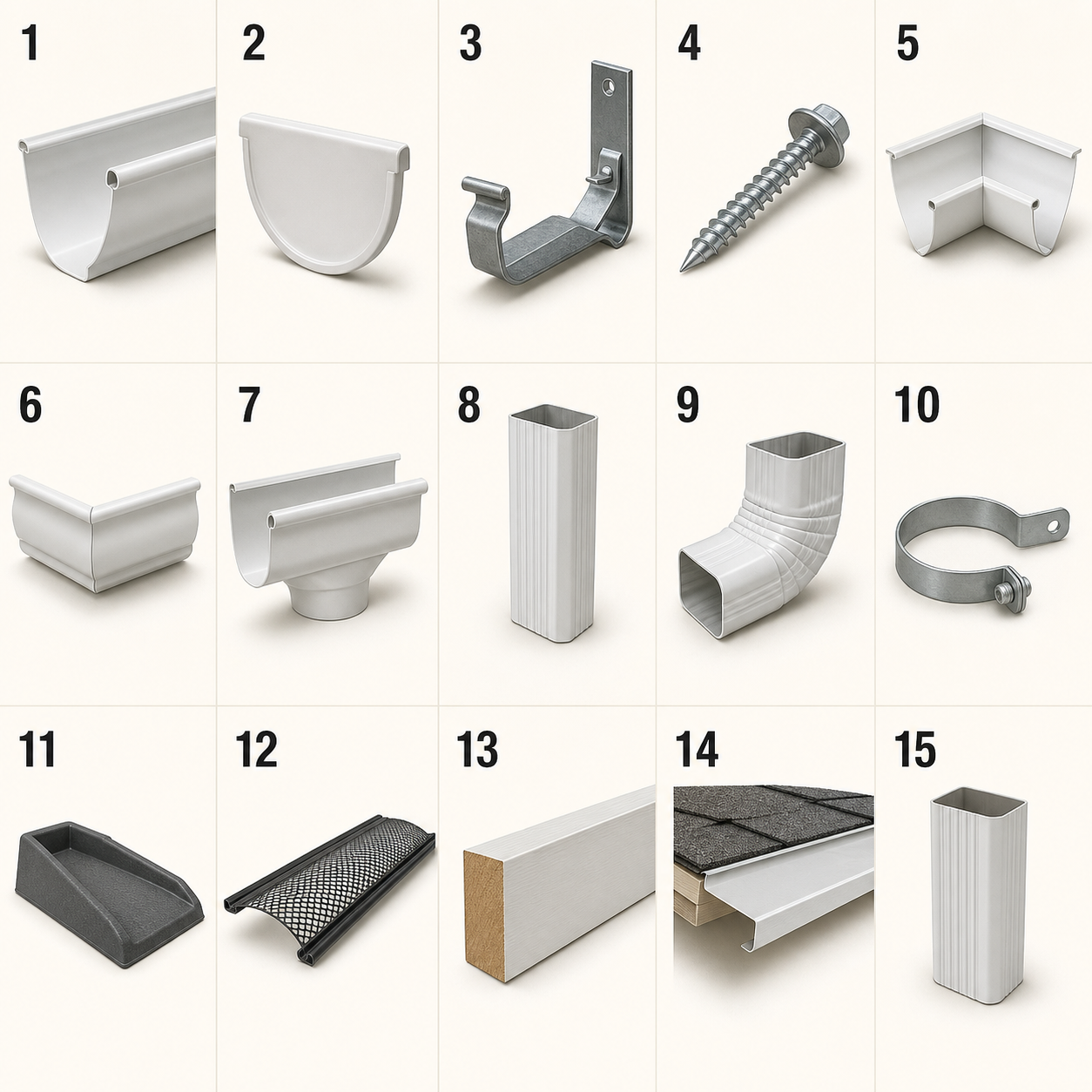
Gutter parts shown in the image
1. Gutter section
The horizontal channel collects runoff from the roof. K-style and half-round profiles are common residential shapes.
2. End cap
An end cap closes the open end of a gutter run and is sealed to prevent leakage.
3. Hidden hanger
The hanger supports the gutter from inside, creating a cleaner exterior appearance than older spike systems.
4. Gutter screw
Long corrosion-resistant screws secure hangers or brackets to sound fascia or structural backing.
5. Inside corner miter
An inside miter joins gutter runs at an internal roof corner and needs a durable sealed joint.
6. Outside corner miter
An outside miter connects runs around an external corner. Expansion and joint movement can stress its sealant.
7. Drop outlet
The outlet forms the transition from the gutter bottom into the downspout.
8. Downspout
The vertical pipe carries collected water toward the ground or an approved drainage connection.
9. Downspout elbow
An elbow changes the direction of the downspout at the eave, wall, or discharge point.
10. Downspout strap
Straps secure the downspout to the wall while allowing the sections to remain aligned.
11. Splash block
A splash block receives discharge and directs it away from the foundation while limiting soil erosion.
12. Leaf guard
A screen or cover reduces the entry of leaves and large debris. No guard eliminates all maintenance.
13. Fascia board
The fascia provides the roof-edge surface to which many gutter hangers attach. Rotten or damaged fascia cannot hold fasteners reliably.
14. Drip edge
This roof-edge flashing directs runoff away from decking and trim and toward the gutter.
15. Downspout extension
An extension moves the discharge farther from the building or toward a suitable surface drainage path.
Common gutter problems
- Overflow at one point: debris, insufficient slope, or a restricted outlet may be involved.
- Water behind the gutter: inspect roof-edge flashing, gutter position, and fascia condition.
- Sagging: hangers may be loose, too widely spaced, or attached to damaged material.
- Foundation puddling: the discharge point or ground slope may be carrying water back toward the building.
Roof-edge work involves serious fall and electrical hazards. Inspect from the ground where possible. High roofs, steep slopes, damaged fascia, overhead service conductors, and concealed drainage connections require qualified professionals.